

Opinion
Tinderbox to Treatment
Leveraging forest restoration funds for capacity and implementation
By Vance Russell, 3point.xyz
2 November 2024
Takeaways
💲Funding. Leveraging public and private funding will be important to scale forest health projects.
🔥Scale. Implementing fuel treatments, including thinning and prescribed fire at scale, can contribute to forest health and WUI resilience.
🚀Capacity. Building system-wide capacities to carry out this work is critical to sustaining our forests and communities in a fiery future.
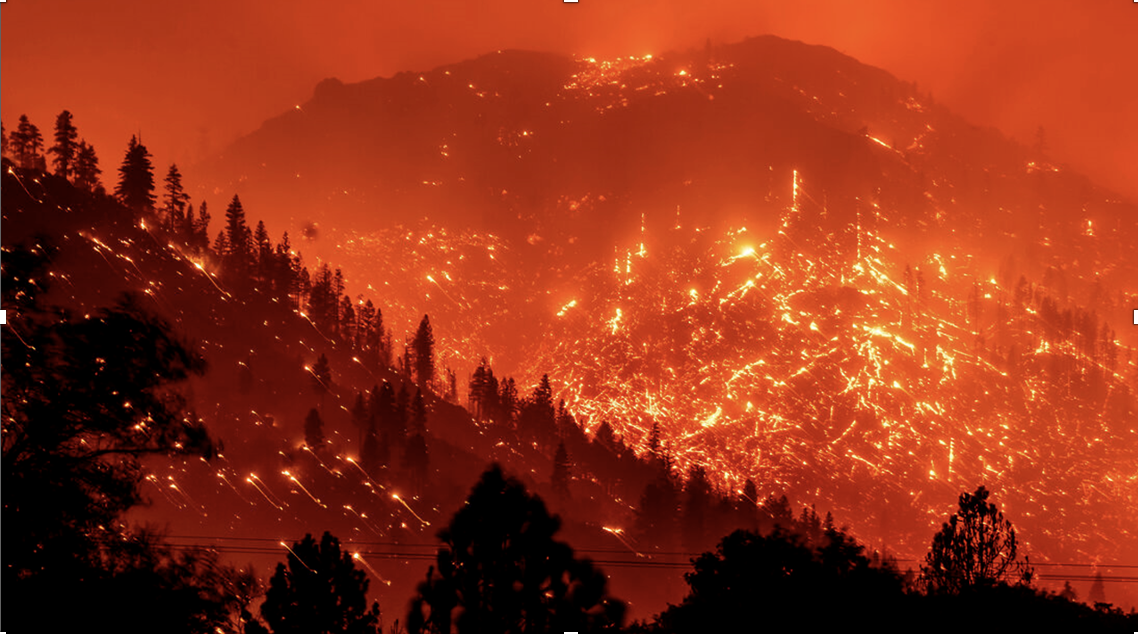
Photo credit Noah Berger/AP
Caldor Fire
In April 2015, I drove up California Highway 50 along the American River Canyon to the Horsetail Falls trailhead to climb Pyramid Peak. There were still patches of snow on the ground, and the water coming down the falls was gushing, making for scenic views up the canyon. While still hiking up through the mixed conifer stands on the trail, I noticed how dense the forest was with small-diameter trees. I left the trailhead and walked through the pines and firs. The thick forest with many small trees had a massive accumulation of downed wood—almost impossible to walk through.
Six years later, one spark caused an explosive firestorm. The Caldor Fire affected 221,835 acres across three counties and destroyed more than 1000 structures over 68 days (CAL FIRE, 2021). Over half the burned acres were classified as high or very high severity.
Reducing these harmful conditions will require integrated social and environmental forest health solutions. Let’s look at how.
Solutions
Proposed solutions to reduce the negative impacts of wildfires generally fall into three buckets: funding, scale, and capacity.
1. Funding
California is investing billions in forest health, betting that increased funding will reduce wildfires. However, public funds cannot cover all project needs (Russell and Odefey, in press[1]). A potential solution is to leverage public-private partnerships, as seen in the Forest Resilience Bond (FRB), developed by Blue Forest and the World Resources Institute. The FRB provides up front capital to finance project work through private investors, like foundations and institutional asset managers, and attracts additional funding through beneficiaries who contribute based on the benefits they experience from the work.
“...The Yuba Forest Resilience Bond will help us finance prevention strategies to stave off the ever-present risk of catastrophic wildfire that can damage national forests and neighboring lands.”
–Eli Ilano, Tahoe National Forest Supervisor
A critical barrier to developing non-traditional finance is the lack of payors or entities that repay initial restoration investments, ideally with a modest return (Odefey and Russell, 2022). The California Wildfire Innovation Fund leveraging private investment in fire mitigation is an example of generating competitive financial returns to solve this problem (Blue Forest, 2024). Fintech should develop platforms to assist funders with connecting implementers.
“As we embrace the challenges of forest restoration we see an invaluable opportunity to raise much-needed capital for holistic community and ecosystem health. This opens the door to strategic, landscape-scale restoration efforts and the establishment of vital infrastructure and workforce capacity for the effective removal and utilization of ladder fuels.”
—Zach Knight, Co-Founder & CEO, Blue Forest
2. Scale
Following the Caldor Fire, CAL FIRE awarded the El Dorado Resource Conservation District (RCD) funding as part of a coordinated and centralized Emergency Forest Restoration Team to prioritize post-fire restoration projects. Known as the Healthy Eldorado Landscape Partnership (HELP), the group has coordinated landscape-scale forest restoration efforts in the Eldorado National Forest. A similar effort is underway following the Dixie Fire on the Plumas and Lassen National Forests, which is helping to create cost and time efficiencies over large landscapes, partly through the SCALE partnership.
Increasingly, fire damages are mainly from grasslands and around the wildland urban interface (State of Fire Tech, 2023). Focusing prevention, mitigation, and suppression efforts in these areas will be the most cost-effective means to reducing fire damages to our communities and infrastructure. Utilizing prescribed fire and letting wildfires far away from communities burn may be the best way to scale forest health restoration and reduce costs associated with fire suppression (Russell and Holst, 2024). The burn matrix in the figure below shows how agencies can prioritize what to let burn or suppress to maximize community protection with forest health.
Organizations and nonprofits should consider shifting from pilots to deliberate testing and scaling successful efforts (FBA guidebook, 2024). The urgency is too great for the “pilot and pray” approach to project development.
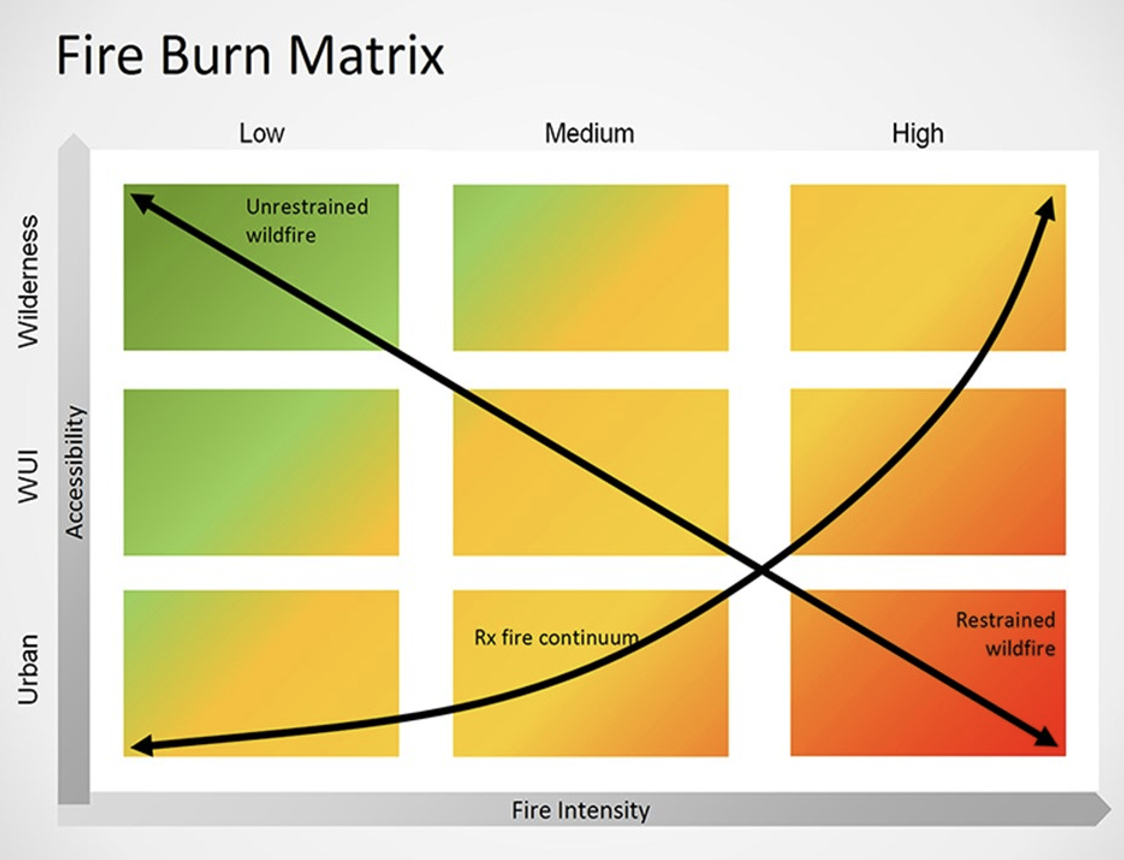
The Fire Burn Matrix Framework.
3. Capacity
Building workforce capacity and capabilities to ably plan integrated projects, develop creative financing solutions, implement the needed array of forest treatments, utilize the removed biomass, safely apply prescribed fire, and measure the outcomes is part of the fire and finance effort (Russell and Odefey, 2022).
In California, CAL FIRE’s Wood Products and Bioenergy Program has an open request for proposals to fund wood products businesses and build local capacity. However, a lack of system-wide capacity and infrastructure to distribute funding remains a critical challenge faced by local agencies and the private sector.
“The California Conservation Corps’ partnership with education institutions is extraordinarily beneficial and one we aim to replicate across the state. Together, we’re helping develop a highly-trained workforce.”
–Bruce Saito, Former California Conservation Corps Director
Parting thoughts
Funding, scale, and capacity will not be the only items needed to change California and the West’s wildfire crisis. Policy change, community health, increased private sector engagement, and more inclusive and equitable approaches are needed to live and work with our fiery future (Wonder Labs, 2023). The fuel load in our forests and communities will not change overnight. However, future disasters can be avoided by considering how funders and implementers can exponentially ramp up existing and new approaches to enable forest health and community resilience.
[1] Russell, V and J Odefey. In press. Conservation finance: Towards and new model for landscape restoration. 3point.xyz.
About the author
Vance Russell has nearly 40 years of experience working in forest science & management, rewilding, biodiversity conservation, agricultural landscapes, restoration, and natural resources management. He is a conservation consultant, principal and owner of 3point.xyz. Vance works for various non-profit, state/federal agencies, and private businesses. Vance was the California Director of Programs for the National Forest Foundation, where he managed, led, and funded community forestry projects. Before joining the National Forest Foundation, he was director of Audubon California’s Landowner Stewardship Program, working with farmers and ranchers to restore habitat compatible with existing agricultural operations. He managed the 7,800-acre Bobcat Ranch and 3,000-acre Mayacamas Mountains Reserve in Yolo and Sonoma Counties, California. Vance is the former Board Chair of Groundswell International, is a trustee for the South Downs National Park Trust, and serves on the Rewilding Leadership Council for the Rewilding Institute. Vance received his M.S. degree in Forest Science and Natural Resources Management from Cornell University and a B.A. in Biology from the College of Wooster.
Email: vance@3point.xyz
Do you have an Opinion to share? Submit here.